
Quartzite vs. Quartz: What’s the Difference and Why Does It Matter?
5th August 2026From Sandstone to Solid Rock: How Nature Creates Quartzite
If you’ve been shopping around for kitchen worktops, you will almost certainly have come across two types of stones with very similar names: Quartz and Quartzite.
Just from these almost identical names alone, its easy to assume they are closely related stones. However despite just a single syllable differentiating them, there actually lies two totally unrelated materials with different origin stories and traits.
If you are feeling confused, or not sure which stone to choose, then fear not its an easy mistake to make. And, we have the full breakdown on how Quartzite and Quartz differ.
The Core Difference: Mother Nature vs. Human Engineering
The simplest way to understand the difference comes down to how each material is created:
- Quartzite is 100% Natural Stone: Quartzite starts its life deep within the earth, formed over millions of years as fine quartz grains from sandstone are subjected to intense heat and pressure. These conditions fuse the grains together into a dense, incredibly solid metamorphic rock. That natural stone is then quarried from the Earth in solid blocks and sliced into slabs, in the same way just marble or granite is. If you ask us, Quartzite is truly an impressive.
- Quartz is engineered and man-made:Unlike Quartzite, quartz slabs are manufactured in a factory by mixing crushed natural quartz crystals (around 90%) with polymer resins and colour pigments. The mixture is compressed under high vacuum pressure and baked into solid sheets.
Heat Resistance: The Ultimate Standoff
How you cook in your kitchen plays a huge role in which material will suit you best.
- Quartzite easily wins on heat. Because it was forged under extreme heat in the earth, natural quartzite is practically immune to high temperatures. You can place hot baking sheets or sizzling frying pans directly onto it without burning or scorch marks.
- Quartz requires a trivet. Because engineered quartz contains plastic resin binders, exposing it to direct, extreme heat can melt or yellow the resin. If you choose quartz, you always need to use a hot pad or trivet under scorching pots.
Look & Design: Unique Patterns vs. Total Consistency
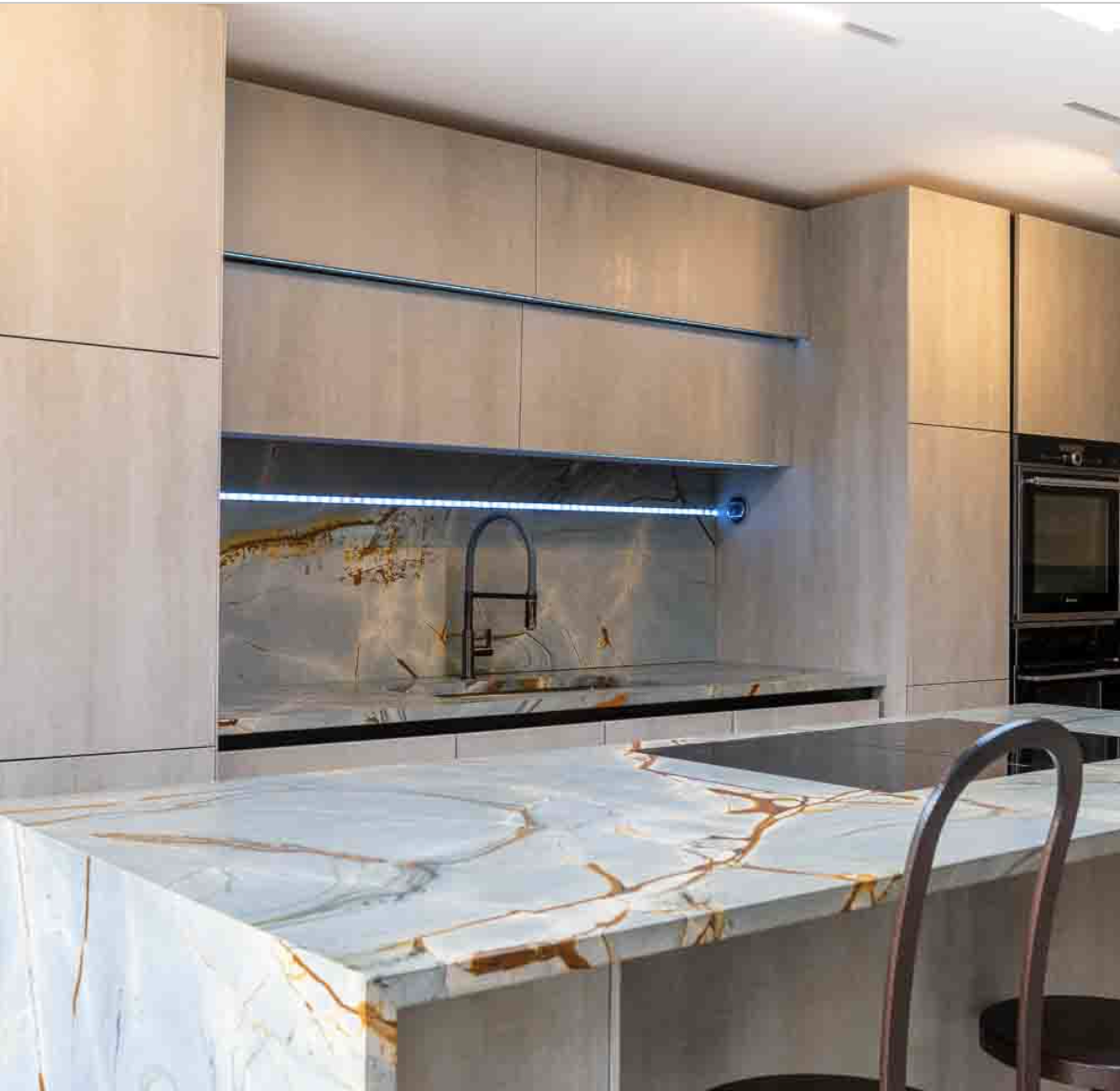
- Quartzite gives you one-of-a-kind art. Because every slab is forged by nature, no two quartzite counters in the world are identical. It often features soft, sweeping, atmospheric patterns that look strikingly similar to high-end marble, but with far greater durability.
- Quartz offers predictable control. If you want a clean white counter with zero unexpected spots, or a specific uniform pattern that perfectly matches your design plan, engineered quartz offers absolute color consistency across every slab.
Maintenance: Sealing vs. Zero Upkeep
- Quartzite needs periodic sealing. Like most natural stones, quartzite is slightly porous. To prevent liquids like red wine or coffee from soaking into the stone, it needs a quick treatment with a penetrating sealer every 1 to 2 years (a simple 5-minute task).
- Quartz is completely non-porous. Because resin seals all the microscopic gaps, engineered quartz never requires sealers or special oils. You simply wipe it down with warm, soapy water.
The Verdict: Which One Should You Choose?
Choose Quartzite if: You love the raw, natural beauty of genuine marble, want maximum heat resistance for heavy cooking, and don't mind sealing the stone every year or two.
Choose Engineered Quartz if: You want a completely hassle-free, non-porous surface with uniform patterns that never needs sealing.
Planning a kitchen project across Hertfordshire, Bedfordshire, or North London? Give our team a call or contact us here, to find out how we can help you create the kitchen of your dreams.